

 Skip to content
Bamboo does not automatically make a property unmortgageable or unsaleable. However, spreading bamboo can overrun gardens, disturb patios and paths, cross boundaries and create a removal liability that buyers, surveyors and valuers may reasonably want investigated.
The important questions are not simply whether bamboo is present, but which growth type it has, whether the rhizomes are contained, how far they have spread and what lies in their path.
If bamboo is appearing away from its original planting area, close to buildings or on both sides of a boundary, an expert bamboo survey can establish the extent of the problem and the most proportionate response.

Problematic bamboo is sometimes described as the next Japanese knotweed, but that comparison can be misleading. Bamboo is widely and lawfully sold as a garden plant. There is no bamboo-specific RICS risk category, no standard lender treatment plan and no equivalent requirement to handle excavated bamboo differently to normal garden waste..
That does not mean bamboo should be ignored. RICS has advised property surveyors to be aware of its ability to spread and to report it where necessary. The sensible approach is a proportionate assessment of the species or growth type, extent, nearby structures and evidence of encroachment.
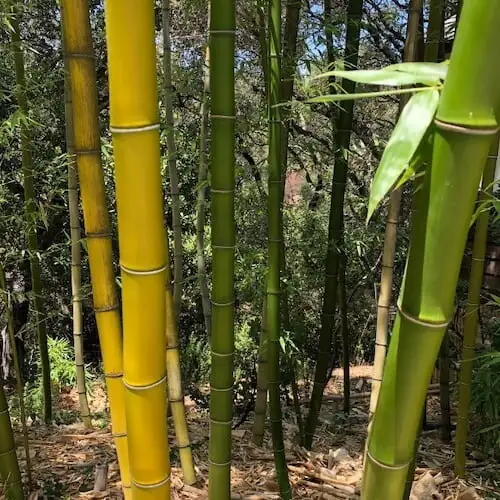
Bamboo is technically a grass, and some species can grow as much as a foot a day. Identifying specific bamboo species can be challenging as there are over 1,400 different ones. The tallest will grow as high as 40 metres and these types of bamboo are most often seen in regions such as South and East Asia. In the UK, as far as bamboo identification is concerned, you are only likely to come across temperate varieties, which, depending on the variety will take one of two growth forms:
Running bamboo spreads through underground stems called rhizomes. New shoots emerge from nodes along those rhizomes, sometimes several metres from the original plant. Clumping bamboo normally expands more locally, although an old or poorly positioned clump can still become large and difficult to remove.
Bamboo is most likely to affect relatively light or vulnerable structures and surfaces. Problems we encounter include:
Bamboo should not be assumed to break through sound concrete foundations. Like many vigorous plants, it is more likely to exploit existing gaps, weak surfaces and favourable growing spaces. The risk therefore depends on the construction, distance, bamboo type and maturity of the infestation.


A healthy bamboo plant remaining within its intended bed is not necessarily a property problem. Investigation becomes more important when:
Above-ground canes do not necessarily show the full affected area. Read more about how bamboo rhizomes spread.
Bamboo in a garden should prompt questions, not an automatic decision to withdraw. A contained clump well away from vulnerable surfaces presents a very different risk from running bamboo emerging across the garden and beneath hard landscaping.
A standard building survey may flag visible bamboo and recommend further investigation, but it will not normally map the underground rhizome system. Where growth is spreading or concealed beneath landscaping, commission a specialist assessment before exchange so that the likely work, disruption and cost can inform the purchase.
Depending on the findings, a buyer might proceed without intervention, request a management plan, renegotiate to reflect removal costs or ask the seller to complete specified work before completion. The appropriate response depends on the individual property rather than the presence of bamboo alone.


There is no dedicated bamboo question equivalent to the Japanese knotweed question in the Law Society’s standard property information process. Nevertheless, sellers should answer enquiries accurately and should not conceal a known problem, dispute, treatment history or damage.
If bamboo is clearly spreading, dealing with the uncertainty before marketing can make the sale easier. Useful evidence may include:
Cutting the canes down immediately before viewings may make the issue less visible without resolving it. New shoots can reappear from the surviving rhizome, and an undisclosed history of encroachment or a neighbour dispute may create a more serious problem during conveyancing, or leave you open to a Misrepresentation claim later once the transaction is complete.
There is no standard percentage by which bamboo reduces a property’s value. Any effect reflects the likely cost and disruption of remediation, the extent of damage, loss of garden amenity, uncertainty about neighbouring land and the reaction of the particular buyer.
Similarly, there is no universal UK lender policy requiring a bamboo treatment plan. A valuer may report extensive or damaging bamboo and recommend further investigation before the lender makes its decision. Individual lenders, valuers and surveyors may take different views depending on the facts.
A documented specialist assessment can reduce uncertainty. Where removal is advised, a clear scope, reinstatement plan, monitoring period and guarantee may help the parties understand the residual risk. They should not be presented as mandatory lender requirements unless the particular lender has said so.


A useful survey should do more than confirm that the plant is bamboo. It should consider:
The resulting proposal should define the area of work and any assumptions or limitations. That is particularly important in a transaction or dispute, where a vague instruction to “remove the bamboo” can leave the parties with different expectations.
There is no standard percentage by which bamboo reduces a property’s value. Any effect reflects the likely cost and disruption of remediation, the extent of damage, loss of garden amenity, uncertainty about neighbouring land and the reaction of the particular buyer.
Similarly, there is no universal UK lender policy requiring a bamboo treatment plan. A valuer may report extensive or damaging bamboo and recommend further investigation before the lender makes its decision. Individual lenders, valuers and surveyors may take different views depending on the facts.
A documented specialist assessment can reduce uncertainty. Where removal is advised, a clear scope, reinstatement plan, monitoring period and guarantee may help the parties understand the residual risk. They should not be presented as mandatory lender requirements unless the particular lender has said so.


Not every bamboo plant must be removed. A manageable clump in a suitable location may need only regular inspection and pruning. Containment can be appropriate where the source is to remain but its spread can be intercepted and the barrier maintained.
Complete removal becomes more attractive where bamboo has already escaped, affects several parts of the property, lies beneath planned works or presents an ongoing boundary risk. Find out how Environet approaches professional bamboo removal.
That depends on the type, position and spread. A contained clump may present little concern; runners appearing across the garden or beneath structures warrant specialist investigation before exchange.
A surveyor may report visible bamboo and associated damage, but a general building survey is not designed to excavate or map rhizomes. A specialist survey may be recommended where the extent is uncertain.
Bamboo is more likely to exploit joints, cracks, edges and other existing weaknesses than to penetrate sound structural concrete. It can still disturb lighter hard landscaping and appear within vulnerable structures.
The standard property information form does not contain a bamboo-specific declaration equivalent to its Japanese knotweed question. Sellers must nevertheless answer enquiries truthfully and should disclose relevant disputes, notices, damage and treatment history. Ask your conveyancer for advice on the particular transaction.
There is no universal lender rule for bamboo. Extensive spread or damage may lead a valuer or lender to request further investigation, but decisions are property- and lender-specific.
Rest assured, where invasive species are identified at an early stage and tackled correctly, problems can usually be avoided. Our specialist consultants complete thorough surveys to identify the extent of the problem. Our plans aren’t one-size-fits-all; they’re customised to tackle the invasive species at your property effectively, taking account of all of your requirements.
“I used Environet following a recommendation to help with invasive Japanese Knotweed in my garden. Very professional, responsive and managed to co-ordinate with other contractors working on my property to remove the knotweed.”
“Richard was able to book us an assessment visit very quickly regarding the encroachment of evasive running bamboo in our garden .. Will completed the assessment visit,we found him to be very professional, but also friendly and easy to talk to. “
“This is a very professional operation; always just on the end of the phone. The whole team seemed to know exactly what was going on with the job. (and my neighbours were very happy too.)”
“I would like to commend your man Ed, who was in charge of the works at our property. He was a pleasure to deal with — punctual, polite, professional, responsible. He always kept me up to date with the progress of the works and made sure there was as little disruption to our lives as possible.”
“I would like to commend your man Ed, who was in charge of the works at our property. He was a pleasure to deal with — punctual, polite, professional, responsible. He always kept me up to date with the progress of the works and made sure there was as little disruption to our lives as possible.”
Our team of experts is available between 9am and 5:30pm, Monday to Friday to answer your enquiries and advise you on the next steps
Want a survey?
If you already know you have an invasive plant problem, you can request a survey online in less than two minutes by providing a few brief details. A member of the team will swiftly come back to you with further information and our availability.
Need quick plant identification?
Simply upload a few images of your problem plant to our identification form and one of our invasive plant experts will take a look and let you know, free of charge what you are dealing with. We’ll also be there to help with next steps where necessary.